Roof Replacement vs Roof Repair – When to Replace Your Roof
Deciding between roof repair and full replacement depends on three factors: your roof’s age, the extent of damage, and the cost of repair relative to replacement. The industry standard “25% rule” provides a clear framework – if repair costs exceed 25% of what a full replacement would cost, replacement is almost always the better financial decision. Use our free Roofing Cost Calculator to estimate your replacement cost, then compare it to repair quotes using the guidance below.
The 25% Rule for Roof Repair vs Replacement
The 25% rule is a widely used industry guideline for making the repair vs replacement decision: if the cost of repairing your roof exceeds 25% of the cost of a full replacement, you should replace the roof instead.
How to apply it:
- Get a replacement estimate for your roof (use our Roofing Cost Calculator for a starting point, then get 2-3 contractor quotes)
- Get a repair quote from a licensed roofer
- Divide the repair cost by the replacement cost
- If the result is 0.25 (25%) or higher, replacement is likely the better choice
Example: Your roof replacement would cost $14,000. A repair quote comes in at $4,200. That is 30% of replacement cost – above the 25% threshold, making replacement the more financially sound decision.
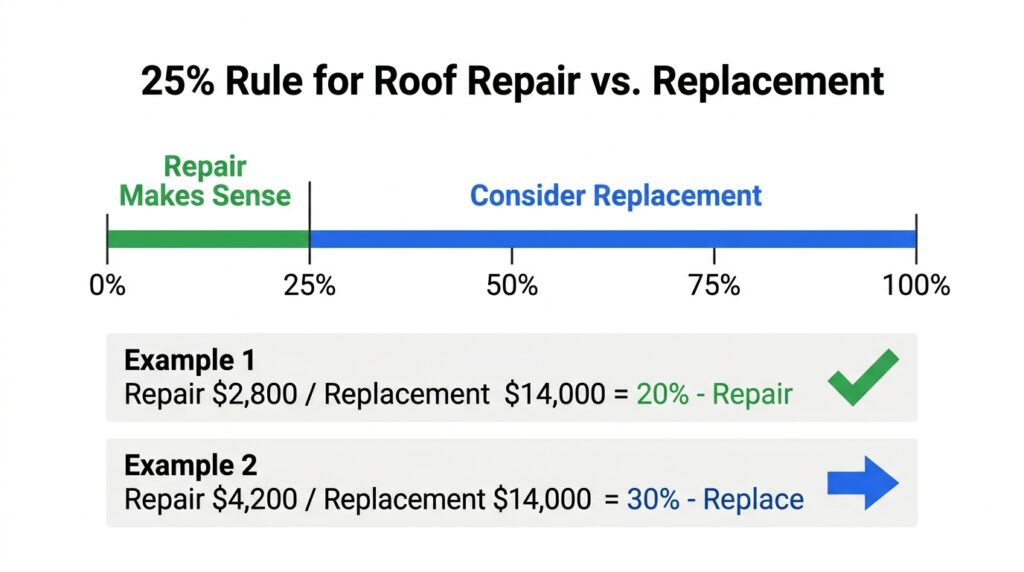
The logic is straightforward: spending $4,200 on a roof that still needs replacement in a few years wastes money you could have applied toward the new roof. Spending $3,000 (21%) on a repair that buys you 5-10 more years is a different calculation entirely.
Repair vs Replacement by Roof Age
Roof age is the most reliable indicator of whether repair or replacement makes more sense:
| Roof Age | Condition | Recommended Action |
|---|---|---|
| Under 5 years | Any damage | Repair – roof is new, likely under warranty |
| 5-10 years | Minor damage (few shingles, small leak) | Repair |
| 5-10 years | Major damage (storm, large section) | Repair if under 25% rule, otherwise replace |
| 10-15 years | Minor isolated damage | Repair |
| 15-20 years | Any significant damage | Evaluate using 25% rule |
| 20-25 years | Recurring leaks or widespread wear | Replace – near end of lifespan |
| 25+ years | Any damage | Replace – past expected lifespan |
A 20-year-old asphalt shingle roof has used approximately 70-80% of its expected lifespan. Repairing it extends a roof that will need replacement within 5-10 years regardless. Unless the repair is minor and inexpensive, replacement is almost always the better long-term decision on a roof this age.
Signs You Need Roof Replacement (Not Repair)
These conditions consistently indicate replacement is the right choice regardless of the 25% rule:
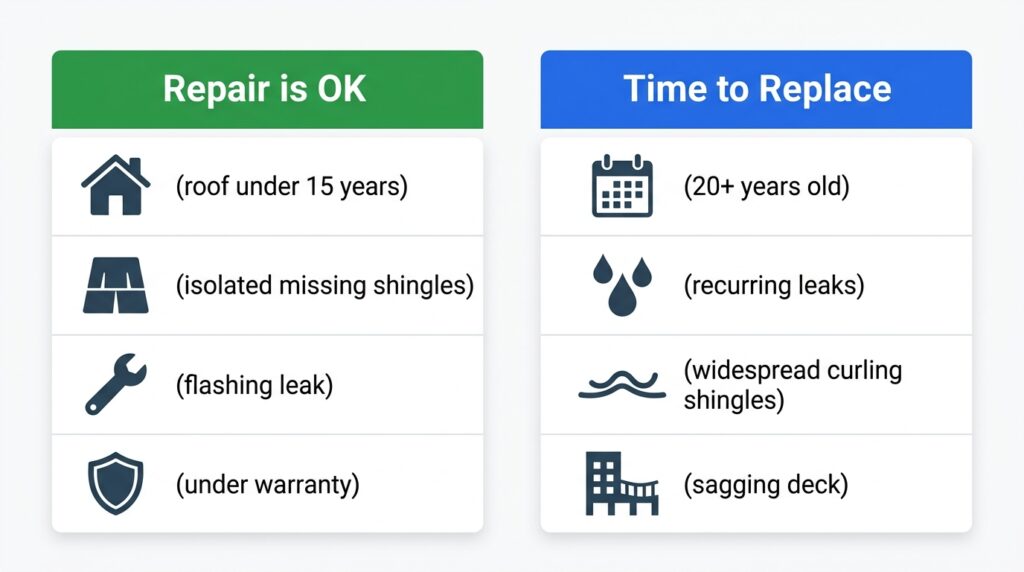
Multiple leaks in different locations – isolated leaks suggest localized damage that repair can address. Multiple leaks in separate areas indicate systemic failure across the entire roof surface.
Widespread granule loss – asphalt shingles shed granules as they age. Heavy granule loss visible in gutters or downspout splash areas indicates the shingles have reached end-of-life and are no longer providing adequate UV protection.
Shingles curling, cupping, or buckling across large areas – individual shingles can be replaced. When curling or cupping is widespread, the problem is systemic and replacement is the only effective solution.
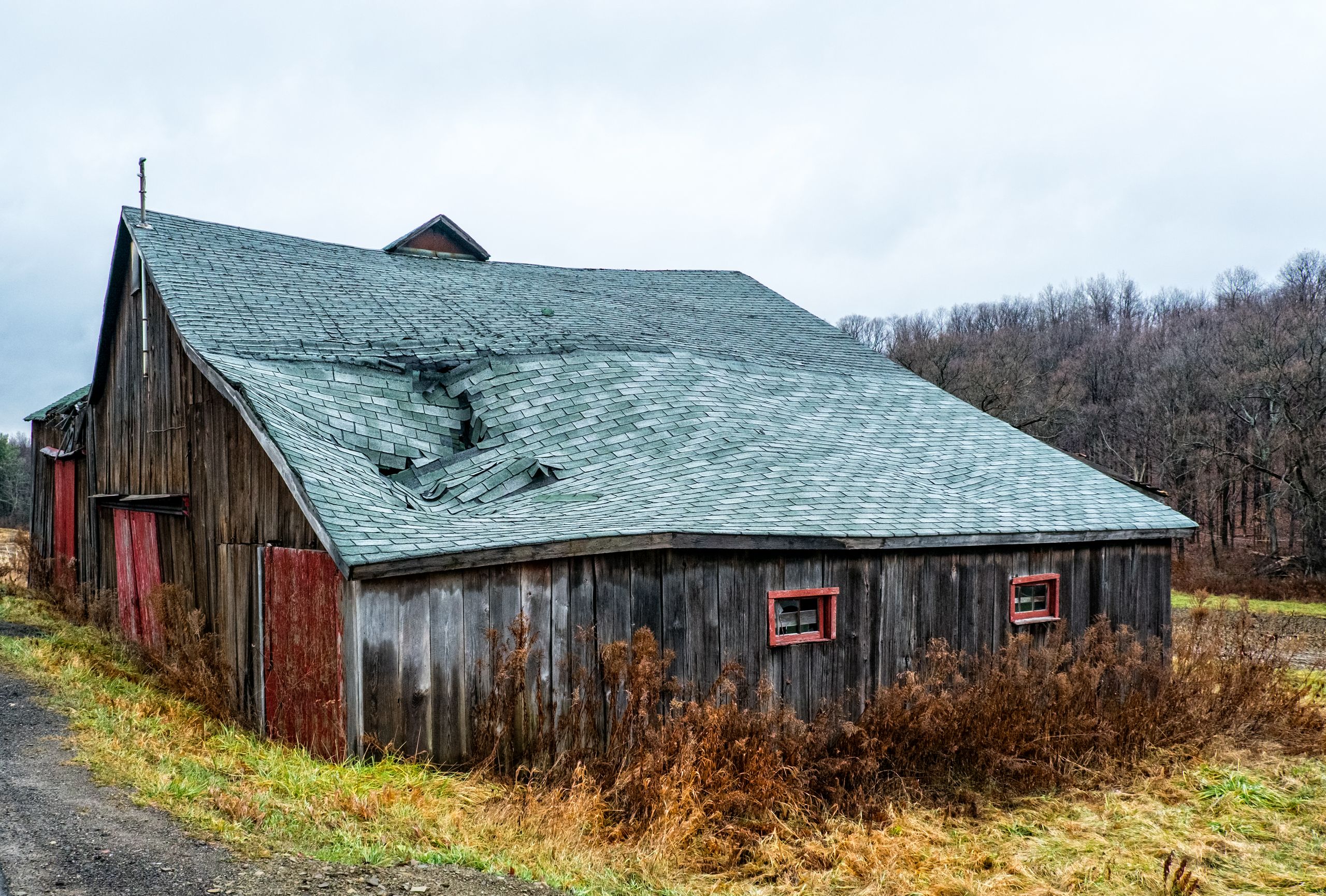
Sagging roof deck – visible sagging or soft spots in the roof deck indicate structural damage (rotted decking or damaged rafters) that goes beyond shingle replacement. This is always a replacement scenario.
Roof fails inspection after major storm – if an insurance adjuster or licensed inspector deems the roof total loss after hail, wind, or other storm damage, replacement is typically covered by homeowner’s insurance.
Moss or algae growth across large sections – surface growth indicates moisture retention and can accelerate shingle deterioration. Minor growth can be treated, but extensive moss growth on an aging roof usually indicates replacement is overdue.
Signs Repair Is Sufficient
These conditions suggest repair is the appropriate choice:
Isolated missing or damaged shingles – 1-10 shingles damaged or missing from a concentrated area (storm debris, branch impact) on a roof under 15 years old is a straightforward repair.
Single leak around a penetration – leaks at chimney flashing, pipe boots, or skylight edges are often flashing failures, not shingle failures. Reflashing is significantly cheaper than replacement ($200-$500 per penetration vs $10,000+ for replacement).
Small section damaged in a recent storm – if less than 10-15% of the roof surface is damaged and the roof is under 15 years old, targeted section replacement is cost-effective.
Roof is under warranty – if the roof is within its manufacturer’s material warranty or contractor’s workmanship warranty period, the repair may be covered at no cost. Always check warranty status before paying for repairs.
Cost Comparison – Repair vs Replacement
| Scenario | Typical Repair Cost | Replacement Cost | Better Choice |
|---|---|---|---|
| 1-5 missing shingles | $150-$400 | $10,000-$20,000 | Repair |
| Small leak (flashing) | $200-$500 | $10,000-$20,000 | Repair |
| Damaged section (10-20 sq ft) | $500-$1,500 | $10,000-$20,000 | Repair |
| Large section repair (100+ sq ft) | $2,000-$5,000 | $10,000-$20,000 | Evaluate (25% rule) |
| Multiple leaks, aging roof | $3,000-$7,000 | $10,000-$20,000 | Often replace |
| Storm damage (50%+ of roof) | $5,000-$10,000 | $10,000-$20,000 | Replace |
Is $30,000 Too Much for a Roof?
$30,000 is at the high end of normal for most residential roofs but not unreasonable in specific circumstances. A $30,000 roof quote is justified for:
- Large homes (3,000+ sq ft with steep, complex roofs)
- Premium materials (metal standing seam, slate, clay tile)
- High cost-of-living markets (coastal California, New York City metro, Boston)
- Significant deck repairs combined with replacement
- Multi-story homes requiring additional safety equipment
For a standard 2,000 sq ft home with architectural asphalt shingles in an average-cost market, $30,000 is above market rate and warrants getting 2-3 additional quotes. For a 3,000 sq ft home with a steep complex roof in a high-cost market using premium materials, $30,000 is within normal range.
Frequently Asked Questions
Get Your Replacement Cost Estimate
Use RoofCalcHub’s free Roofing Cost Calculator to estimate your roof replacement cost before meeting with contractors. Having a baseline number helps you apply the 25% rule accurately and negotiate from an informed position. For a detailed materials breakdown, also see our Roofing Material Calculator.