How to Measure Roof Pitch – 5 Methods Without Going on the Roof
You can measure roof pitch safely without climbing on the roof using 5 methods: the attic rafter method, the gable end measurement, a smartphone inclinometer app, speed square on the rake board, or Google Earth satellite imagery. The most accurate free method is the attic measurement – it takes under 5 minutes with a level and tape measure. Once you know your pitch, use our free Roof Pitch Calculator to convert it to degrees, slope percentage, and area multiplier for material estimates.
Method 1 – Measure from the Attic (Most Accurate)
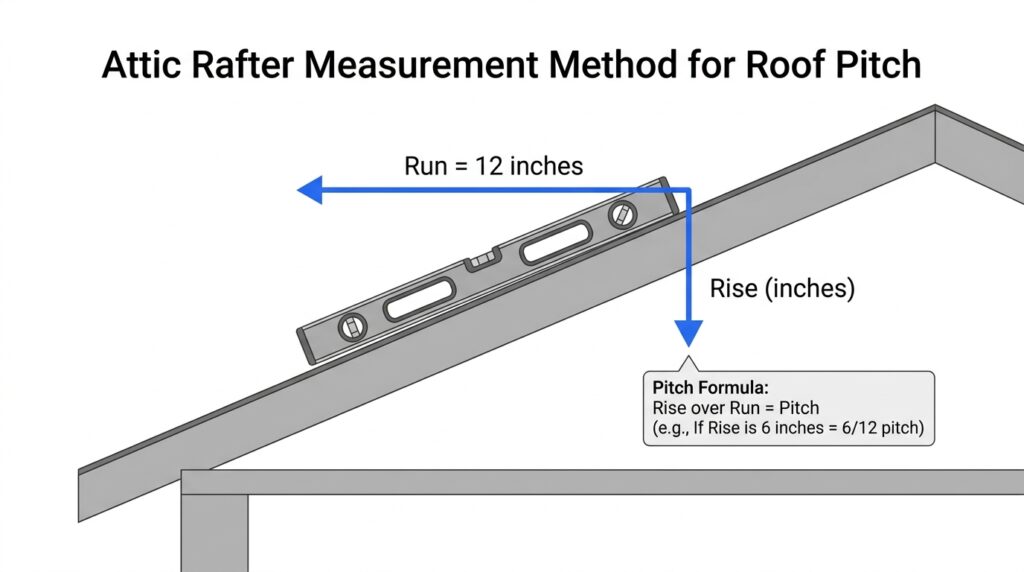
Measuring from inside your attic is the safest and most accurate way to find your roof pitch without getting on the roof. You need a 12-inch level and a tape measure.
Step-by-step:
- Go into your attic and locate an exposed rafter (the angled wooden beam following the roof slope)
- Hold your 12-inch level horizontally against the bottom edge of the rafter
- Make sure the bubble in the level is centered (the level is perfectly horizontal)
- From the 12-inch mark on the level, measure straight down vertically to the rafter surface
- The vertical measurement in inches is your rise – your pitch is that number over 12
Example: If you measure 6 inches vertically at the 12-inch horizontal mark, your pitch is 6/12.
This method works on any rafter from inside and gives you the exact pitch without any estimation.
Method 2 – Measure at the Gable End from the Ground
If you cannot access your attic, you can estimate pitch from outside by measuring the gable end of your home – the triangular wall section visible at each end of a gable roof.
Step-by-step:
- Stand back from your home so you can see the full gable end (triangular peak)
- Measure the total width of the house at the base of the gable (the horizontal span)
- Measure the height of the gable from the eave line to the peak
- Divide the height by half the width to get the pitch ratio per 12 inches of run
Example: House width 30 ft, gable height 7.5 ft. Half width = 15 ft. 7.5 divided by 15 = 0.5. Multiply by 12 = 6. Pitch is 6/12.
This method requires a long tape measure or laser distance meter and is less precise than the attic method due to measurement difficulty from ground level.
Method 3 – Use a Smartphone App (Fastest)
Several free smartphone apps measure roof pitch using your phone’s built-in inclinometer (gyroscope sensor). This is the fastest method and requires no measuring tools.
For iPhone:
- Open the Measure app (built into iOS)
- Tap the Level tab at the bottom
- Hold your phone flat against the rake board (the sloped trim piece at the gable end of your roof) or against a rafter in your attic
- The app displays your roof angle in degrees automatically
For Android:
- Download a free bubble level app (search “clinometer” or “level” in Google Play)
- Same process – hold against rake board or rafter, read the angle
Converting degrees to pitch ratio: Use our Roof Pitch Calculator – switch to “Angle” mode, enter your degrees, and it converts to X/12 format instantly.
This method is excellent for getting a quick, reasonably accurate reading without any measuring tools beyond your phone.
Method 4 – Speed Square on the Rake Board
A speed square (also called a rafter square or framing square) is a triangular metal tool available at any hardware store for $10-$15. It gives a direct pitch reading without any math.
Step-by-step:
- Stand at the gable end of your home near the roofline (you may need a small ladder to reach the rake board)
- Hold the speed square’s pivot point against the rake board (sloped edge trim)
- Hold the square level using the built-in bubble
- Read the pitch directly from the “Common” scale on the square – the number where the rake board intersects the scale is your rise per 12 inches
This method is popular with contractors for quick on-site pitch checks. It requires getting close to the roofline but does not require actually stepping onto the roof surface.
Method 5 – Google Earth Satellite Imagery
Google Earth Pro (free) allows you to estimate roof pitch using satellite imagery and terrain data, though this method is less accurate than direct measurement.
Step-by-step:
- Open Google Earth Pro (free download at earth.google.com)
- Search your home address
- Use the 3D tilt view to observe your roof angle
- Use the measurement tool to estimate the ridge height vs horizontal span
This method gives a rough estimate only – accuracy depends on the resolution and age of satellite imagery in your area. Use it only when no direct measurement is possible, then verify with another method before ordering materials.
Which Method Should You Use?
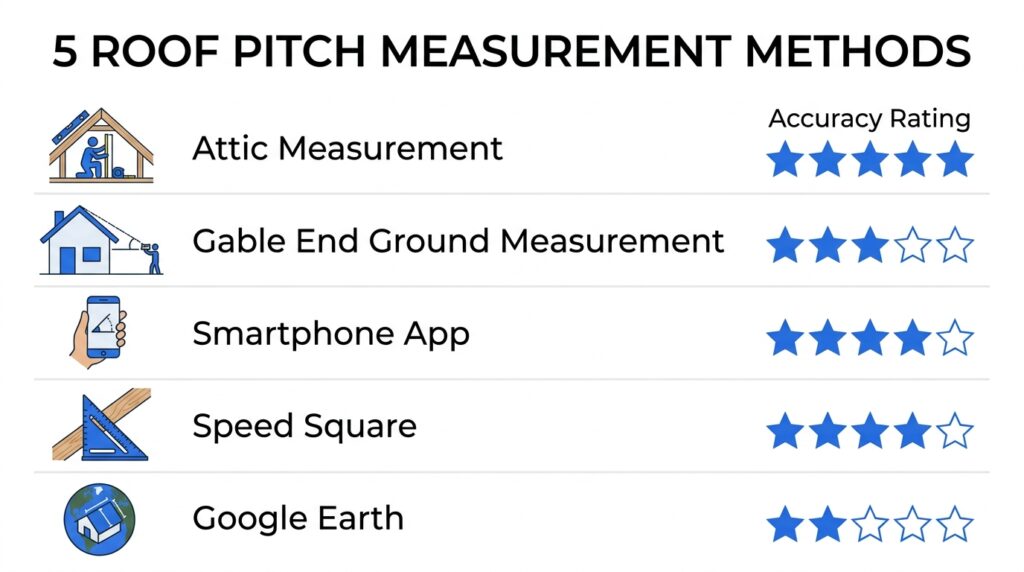
| Method | Accuracy | Tools Needed | Time Required |
| Attic measurement | Highest | 12″ level + tape measure | 5 minutes |
| Gable end measurement | Moderate | Tape measure / laser | 10 minutes |
| Smartphone app | Good | Your phone | 2 minutes |
| Speed square | High | Speed square ($10-15) | 3 minutes |
| Google Earth | Low | Computer + internet | 5 minutes |
For most homeowners, the smartphone app is the quickest starting point. If you need precision for a material order, follow up with the attic rafter method to confirm.
Frequently Asked Questions
Calculate Your Roof Area After Measuring Pitch
Once you know your pitch, use RoofCalcHub’s free Roof Pitch Calculator to convert between pitch formats and find your area multiplier. Then use the Shingle Calculator to estimate materials based on your actual roof dimensions and pitch.